The Shortage Is Not of Men, but of Sacrifice
A reply to Father Dwight Longenecker. Ordaining married deacons would not solve the priest shortage.
- Date
- Category
- Reading time
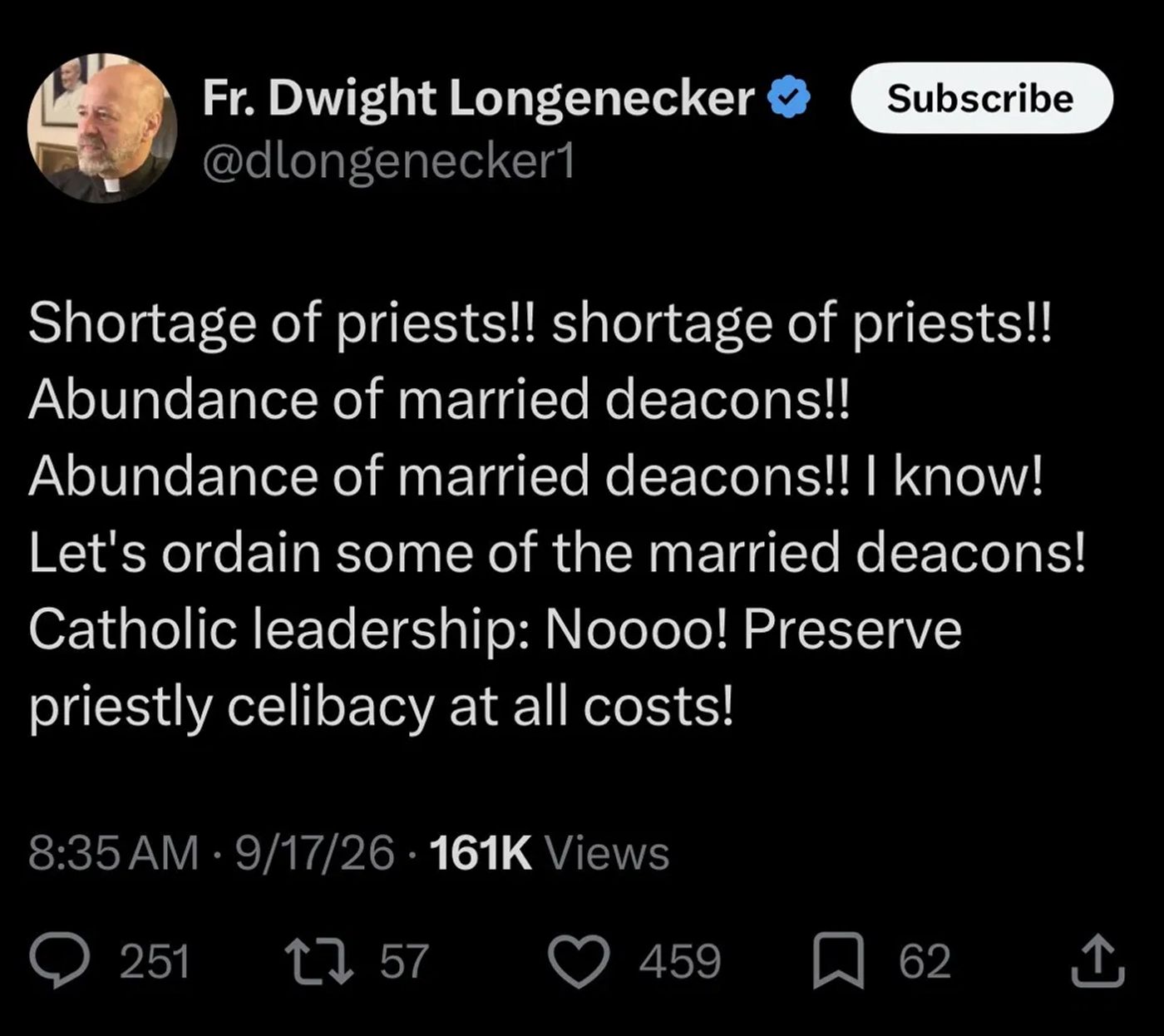
Fr. Longenecker's recent post on X has the appeal of simple arithmetic to solving the shortage of priests in the Church today: too few priests, plenty of married deacons, so why not ordain the deacons and the problem is solved. Only an obstinate hierarchy clinging to celibacy "at all costs" stands in the way. While it’s a clever argument, it treats the shortage as a staffing problem, as if the Church were a franchise short on managers. The Catholic priesthood isn’t a job needing to be filled, but is a sharing in the priesthood of Jesus Christ, and the discipline that surrounds it grows from what the priesthood is, not from whatever is the administrative preference.
I write with respect for Fr. Longenecker, who came into the Church from Anglicanism and was ordained as a married man under a special provision by Benedict XVI. The Church made that exception generously for converts, and his priesthood is valid and real. But an exception made out of charity for a particular situation cannot become the model for the Latin Church without changing the thing it was an exception to.
The priest is an image of Christ the Bridegroom
The priest stands at the altar in persona Christi. When he says "This is my Body," he does not speak about Christ; he speaks as Christ. Our Lord was a virgin, and He remained one, because His whole life was given to His Bride, the Church. The celibate priest is not simply following a rule. He is conformed in his body and his affections to the One whose sacrifice he offers. His undivided heart, as St. Paul says, belongs to "the things of the Lord" (1 Cor 7:32–33).
This is why Pius XI in Ad Catholici Sacerdotii1 and Paul VI in Sacerdotalis Caelibatus2 did not defend celibacy mainly as a matter of practicality. They defended it as a fitting sign: the priest espoused to the Church, spiritually fruitful, freed for a fatherhood that reaches every soul entrusted to him. To treat it as an obstacle to be removed when numbers are low is to misunderstand what it signifies.
The ancient discipline was continence, not merely celibacy
Critics routinely point out that the early Church ordained married men, beginning with St. Peter himself. That is true, and cannot be denied. But the question is what happened after ordination. Scholars such as Christian Cochini, Cardinal Alfons Stickler, and Stefan Heid have shown that the early Church expected married clerics to live in perfect continence with their wives once ordained.
The evidence is actually quite striking. The Council of Elvira3 in Spain, around the year 305, forbade bishops, priests, and deacons to have relations with their wives. Pope Siricius,4 writing in 385, treated clerical continence as a settled obligation, not an innovation. The Council of Carthage5 in 390 required continence of bishops, priests, and deacons, saying that this preserved what the apostles taught and antiquity itself observed. These were not councils inventing a new burden. They were defending an inheritance.
So when St. Peter says, "Behold, we have left all things and followed thee" (Mt 19:27), and Our Lord promises reward to those who leave "house, or parents, or brethren, or wife" for the kingdom (Lk 18:29), the tradition has understood this as a real renunciation. Peter may well have remained married in name, and his wife may have accompanied him, but the ancient witness suggests that they lived as brother and sister so that he could give himself wholly to the mission Christ gave him. The married apostles are not an argument against clerical continence. They are its first example.
The Eastern churches, since the Council in Trullo in 692, permitted married priests to use marriage except before celebrating the liturgy. The Church has never condemned that discipline, and Eastern Catholic priests are true priests. But the Latin Church has always understood its own practice as the more faithful preservation of the apostolic norm. Fr. Longenecker's proposal would not return us to the early Church. It would take us further from it.
The deacon at the altar
This brings me to a question many traditional Catholics feel but rarely say aloud: the restored permanent diaconate itself. The deacon is not a layman with extra duties. He receives Holy Orders, enters the clerical state, and serves at the altar of sacrifice. The ancient canons bound deacons to continence alongside priests and bishops, precisely because they belong to the same sacred order.
The permanent diaconate restored after the Second Vatican Council6 introduced something the early Church does not appear to have known: a married cleric serving at the altar with no expectation of continence at all. Even the current Code of Canon Law, in canon 277,7 obliges clerics to "perfect and perpetual continence," and serious canonists have argued that the plain text reaches married deacons too. Rome has not applied it that way, but the tension within the law itself tells us something. The Church's own legislation still carries the memory of the older discipline, even as practice has moved away from it.
None of this is an accusation against any particular deacon, most of whom serve generously and in good faith. It is a concern about the principle. If the altar calls for an undivided heart, then the unease many of us feel is not prudishness. It is the instinct of the tradition.
The real shortage
Fr. Longenecker assumes celibacy is the cause of the vocations crisis, but the evidence says otherwise. Protestant denominations with married clergy, and even married women clergy, face their own shortages. Meanwhile, the seminaries of traditional Catholic communities, which present the priesthood as total sacrifice and teach celibacy without apology, continue to draw young men in droves. It’s not a matter of numbers, but a matter of the heart. Vocations flourish where the priesthood is proposed as something worth giving one's whole life for.
Again, the problem is not the discipline, but rather it is the heart of modern man, formed by a culture that treats continence as impossible and sacrifice as irrational. Lowering the standard will not heal that heart. It will only confirm the lie that the self-gift Christ asks for is too much.
Fr. Longenecker pokes fun at the Church for wanting to preserve priestly celibacy "at all costs." But in a sense, that is exactly right. Some things are worth preserving at great cost, because what is at stake is not a policy but an image of Christ Himself, offered daily at the altar by men who have given Him everything.
Questions this raises
Did the early Church ordain married men?
Yes, beginning with St. Peter, cannot be denied. The question is what happened after ordination. The Council of Elvira (c. 305), Pope Siricius in 385 and the Council of Carthage in 390 required married bishops, priests and deacons to live in perfect continence with their wives, and presented this as an apostolic inheritance rather than a new burden.
What is the difference between celibacy and continence?
Celibacy means not marrying. Continence means abstaining from marital relations. The ancient discipline bound married clerics to continence once they were ordained, which is why the married apostles are not an argument against the Latin Church’s practice.
Would ordaining married deacons solve the priest shortage?
The evidence says no. Protestant denominations with married clergy, including married women clergy, face their own shortages, while the seminaries of traditional Catholic communities that teach celibacy without apology continue to draw young men. The shortage is of sacrifice, not of available men.
Are married Eastern Catholic priests real priests?
Yes. Since the Council in Trullo in 692 the Eastern churches have permitted married priests to use marriage except before celebrating the liturgy, and the Church has never condemned that discipline. The Latin Church has understood its own practice as the more faithful preservation of the apostolic norm.
Does Church law still require continence of married deacons?
Canon 277 of the 1983 Code obliges clerics to perfect and perpetual continence, and serious canonists have argued that the plain text reaches married deacons too. Rome has not applied it that way, but the tension within the law preserves the memory of the older discipline.
Notes
- Pius XI, Ad Catholici Sacerdotii (Encyclical on the Catholic Priesthood), December 20, 1935, Acta Apostolicae Sedis 28 (1936): 5–53, in the section on priestly chastity.Back
- Paul VI, Sacerdotalis Caelibatus (Encyclical on Priestly Celibacy), June 24, 1967, Acta Apostolicae Sedis 59 (1967): 657–697, esp. nos. 19–34, on the Christological, ecclesiological, and eschatological meaning of celibacy.Back
- Council of Elvira (c. 305), canon 33. Elvira was a local Spanish synod rather than an ecumenical council, but it is the earliest surviving legislation on clerical continence.Back
- Siricius, Directa ad decessorem (Letter to Himerius, Bishop of Tarragona), February 10, 385, ch. 7; Heinrich Denzinger and Peter Hünermann, eds., Enchiridion Symbolorum, 43rd ed. (San Francisco: Ignatius Press, 2012), no. 185. This is the letter in which Siricius rebukes clerics who appealed to Old Testament precedent.Back
- Council of Carthage (390), canon 2, in Charles Munier, ed., Concilia Africae A. 345–A. 525, Corpus Christianorum Series Latina 149 (Turnhout: Brepols, 1974), 13. The canon was later received into the Codex canonum Ecclesiae Africanae(419).Back
- Second Vatican Council, Lumen Gentium (Dogmatic Constitution on the Church), November 21, 1964, no. 29; Paul VI, Sacrum Diaconatus Ordinem (Motu Proprio), June 18, 1967, Acta Apostolicae Sedis 59 (1967): 697–704.Back
- Can. 277 §1. Clerics are obliged to observe perfect and perpetual continence for the sake of the kingdom of heaven and therefore are bound to celibacy which is a special gift of God by which sacred ministers can adhere more easily to Christ with an undivided heart and are able to dedicate themselves more freely to the service of God and humanity.Back
Sources
- Pius XI, Encyclical Ad Catholici Sacerdotii (1935)
- Paul VI, Encyclical Sacerdotalis Caelibatus (1967)
- Council of Elvira (c. 305)
- Pope Siricius, Letter to Himerius of Tarragona (385)
- Council of Carthage (390)
- Council in Trullo (692)
- Second Vatican Council, Lumen Gentium (1964)
- Paul VI, Motu Proprio Sacrum Diaconatus Ordinem (1967)
- Code of Canon Law (1983)
- Christian Cochini, Alfons Stickler and Stefan Heid on the apostolic origins of clerical continence
- Scripture: 1 Cor. 7:32–33; Mt. 19:27; Lk. 18:29


Did Benedict XVI Validly Resign? The Anatomy of a Renunciation, Part II
Eight objections to the claim that Benedict XVI’s resignation was invalid, each stated and answered from the law of the Church and from his own words.
Did Benedict XVI Validly Resign? The Anatomy of a Renunciation, Part I
Benedict XVI believed he could lay down the governance of the papacy while sustaining an indelible link to the Petrine Office, and the Church’s law says a resignation made in such substantial error is invalid by the law itself.

May a Catholic Ask Who Is Pope?
Before asking whether Benedict XVI validly resigned, we must ask whether a Catholic may ask such a question at all. The Church’s law, her theologians, and her history answer: yes, within limits.