The Peaceful Acceptance of the Church
The strongest objection to this series, stated in the words of Billot, John of St. Thomas, and Wernz, and an honest account of where it leaves the case.
- Date
- Category
- Reading time
The Objection That Could End This Series
Everything argued so far in this series could be correct as a matter of canon law and still fail before a single principle of theology. It runs like this. Christ promised that the gates of hell would not prevail against His Church. The Church follows the pope as her living rule of faith. If the whole Church could accept as pope a man who is not pope, she would be following a false rule of faith, and that Christ’s promise forbids. Therefore, whenever the whole Church peacefully accepts a man as pope, that acceptance is an infallible sign that he is pope, and that every condition required for his legitimacy was met.
In March 2013 the Church accepted Francis, and in May 2025 she accepted Leo XIV. If the principle applies to those events without qualification, this series has no case whatsoever, however strong its reading of canon 188 may be. We promised that we would meet this objection on its own terms, and that we would not hide from it, and we intend to keep both promises. We will state the principle in its strongest form, in the words of the theologians who formulated it, before saying anything in reply.
I. The Principle in Its Strongest Form
No one stated it more forcefully than Cardinal Louis Billot, the Jesuit theologian whose treatise on the Church was a standard text in Rome for decades. God, he wrote, can permit the See of Peter to remain vacant for a long time. He can permit doubt to arise about the legitimacy of one or another man elected. “But He cannot permit that the whole Church admit as pontiff one who is not true and legitimate.” And so, once a pope has been received and joined to the Church as head to body, the question of any defect in his election, or of the lack of any condition necessary for his legitimacy, may no longer be raised, because the Church’s adherence “radically heals every defect of the election and infallibly shows the existence of all the required conditions1.” Billot even applied the principle against a historical challenge. When Savonarola claimed to have proof that Alexander VI was a heretic, Billot answered that all Christendom adhered to Alexander and obeyed him as pope; therefore Alexander was a legitimate pope2.
John of St. Thomas, writing three centuries earlier, built the same conclusion on the nature of the papacy itself. The pope is a living rule of faith, as the canonical Scriptures are a written one, and just as the Church cannot err in receiving a book as Scripture, she cannot err in receiving a man as the supreme rule of her faith. Once she has peacefully accepted him, it is of faith that this man is pope; that he was baptized, rightly elected, and possessed every other required condition follows as a theological conclusion. Indeed, he says, it is inferred that God will not permit one to be elected and peacefully accepted by the Church who lacks the conditions the office requires3.
He adds two points that make the principle harder still for our case. First, the acceptance happens almost at once. It takes place “negatively,” he says, as soon as the Church, wherever she learns of the election, does not contradict it, and positively as her prelates receive the new pope, first in Rome and gradually throughout the world4. Second, to deny a pope after he has been “peacefully and canonically accepted” is not merely schism but heresy, because it rejects the rule of faith the Church has received5.
The canonists would certainly agree. Wernz, citing earlier authorities, notes that no exception may be raised against a pope who has been elected and received by the whole Church. The Church’s consent, he explains, is not itself an election and does not make a man pope who was not elected; it is “not the cause, but the sign and infallible effect of a valid election.” Conversely, when the whole Church abandoned the Avignon claimant Peter de Luna, that was a certain sign he had never been pope6.
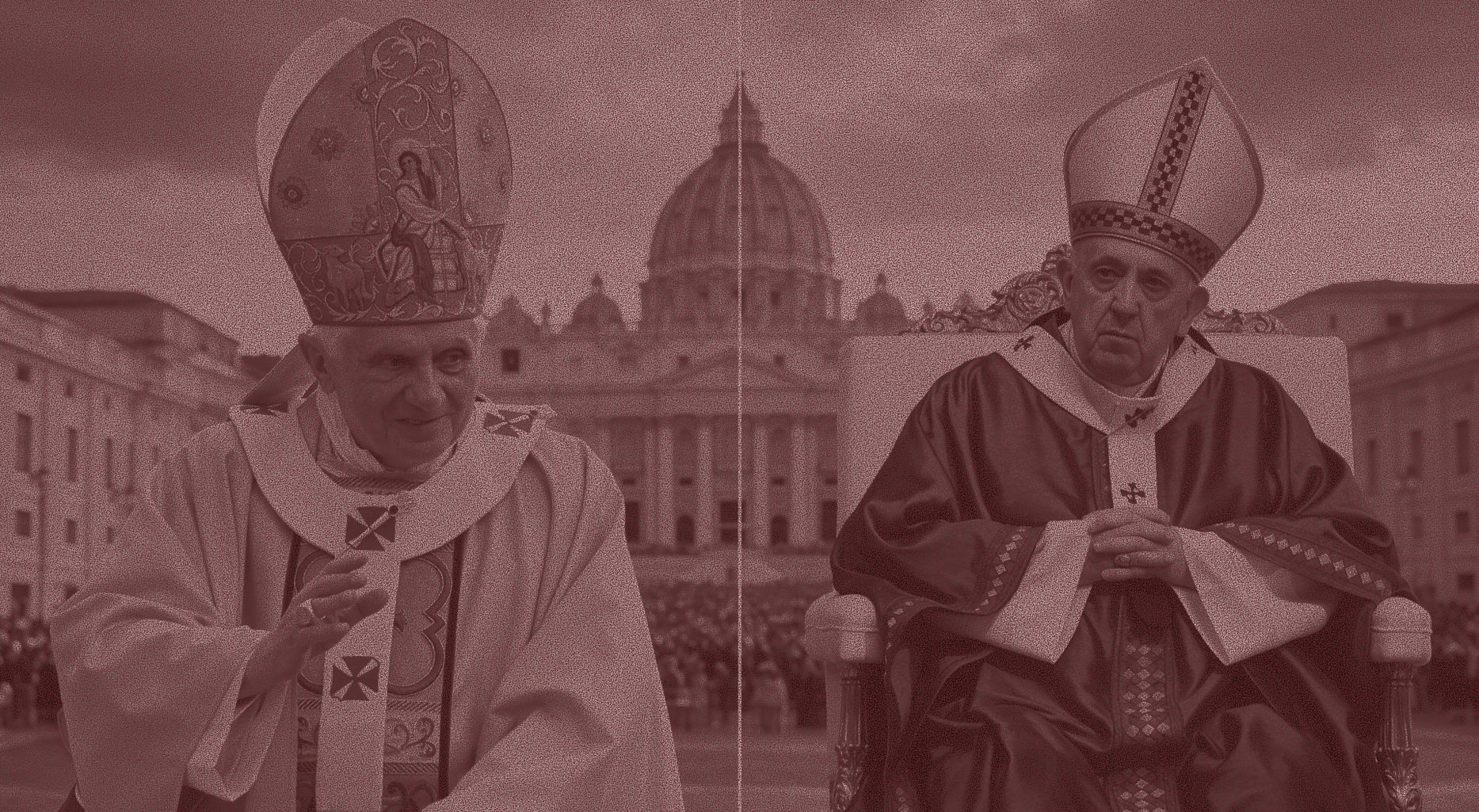
Now set these words beside the events of 2013. On March 13, the cardinals elected Jorge Mario Bergoglio without protest from any cardinal. The bishops of the world received him. Benedict himself, on the last day of his pontificate, had already promised his “unconditional reverence and obedience” to the man the cardinals would choose7. By John of St. Thomas’s measure, the Church’s acceptance was complete within days. We will not pretend this is anything other than what it appears to be and which is the strongest case against this series that exists.
II. The Shortcut We Must Not Take
There is a tempting reply, and we want to bring it to light so that we can refuse it plainly. Some would say something like this: the principle of acceptance presupposes a vacant See; Benedict’s renunciation was void, so the See was never vacant; therefore the acceptance of 2013 was the acceptance of a man who could not have been pope, and the principle does not apply.
That argument is circular, and any honest reader would notice that. But the whole point of the principle is to tell us whether the conditions of a legitimate election were met. A vacant See is one of those conditions, perhaps the first of them. Billot says in so many words that the Church’s adherence shows the existence of all the required conditions, without exception. To answer the principle by assuming that one of those conditions was absent is to assume the very thing in dispute. If we argued that way, we would deserve every charge of special pleading our critics could bring.
So the question cannot be dodged, and there are only three honest ways forward. Either the principle does not carry the weight its strongest defenders claim for it; or its own conditions were not met in 2013; or our reading of canon 188 is mistaken somewhere. We take up the first two in turn, and we leave the third open, as any honest inquirer must.
III. What Kind of Certainty Is This?
Begin with the principle’s standing. It is not a defined dogma. No council and no pope has solemnly defined that the peaceful acceptance of a particular man proves his legitimacy. It is a theological conclusion drawn from the Church’s indefectibility, and a weighty one, held by many of the Church’s greatest theologians. But the theologians themselves did not agree on how certain it is.
John of St. Thomas is actually quite candid about this. He reports that several theologians of his own day and before, among them Alfonso de Castro and, with some hesitation, Melchior Cano and Domingo Bañez, held that the legitimacy of a particular pope is known not by divine faith but by moral certainty, the kind of certainty we have about any well-attested human fact8. He disagrees with them, but he states his own view with care: “it has seemed to us more probable” that the Church’s acceptance makes it a matter of faith9. More probable, yes, but not certain.
We must be equally candid about the other side of that ledger. Even the theologians who denied that a particular pope’s legitimacy is a matter of faith did not think it could be lightly questioned. Bañez, by John of St. Thomas’s report, held it “very rash and scandalous” to deny that a man accepted by the Church is truly pope, unless one could show some definite defect, such as that he had never been baptized or was not a man10. The lower view of the principle’s certainty does not make it weak. It means only that it is a moral certainty that yields to proof of a definite defect. That is a heavy burden, and Essay 1 accepted it on this series’ behalf.
Healing or sign?
The authorities also disagree about how the principle works, and the difference matters. Billot says the Church’s adherence “radically heals” every defect of an election. On that view, acceptance acts almost like a cure: whatever was wrong is put right.
Wernz and Vidal, however, will not say this. The Church, they argue, cannot grant papal jurisdiction, which she does not possess, to a man invalidly elected, and God will not grant it either. Acceptance therefore cannot work like a second election that repairs the first. If it did, it would require that the whole Church had once been in error about a false pope, which theologians exclude. Instead, they hold, Providence so arranges things that a defect in an election becomes known to the Church11. Wernz, as we saw, makes the same point in one line: acceptance is a sign and effect of a valid election, not its cause.
On the Wernz-Vidal view, acceptance cannot cure a renunciation that was void by the law itself. It can only indicate, infallibly, that there was no such defect, and so everything turns on whether the conditions under which that sign is infallible were actually present. And Wernz and Vidal add their own expectation: where there is a real defect, Providence will see that it comes to light. Here we must be fair to both sides. Benedict’s understanding of his act did come to light, publicly and in his own words, as Essay 2 showed. But Wernz and Vidal also reason, in the case of Gregory VI, from the undisputed acceptance of a successor back to the validity of the resignation before him12. Their framework does not settle our case either way. What it does is move the whole weight of the question onto one word.
IV. The Word Every Formulation Shares: “Peaceful”
Read the classical statements again, slowly, and one qualifier appears in every one. Billot’s thesis does not speak of the Church’s adherence simply, but of her peaceful adherence, pacificam adhaesionem. John of St. Thomas says the Holy Spirit’s guidance of an election is complete only when the election “is peacefully concluded,” and that while it remains doubtful it is not yet complete. When an election is “not peaceful and peacefully accepted, but reasonably doubtful,” the man elected cannot resolve the doubt himself; the Church must. The acceptance that suffices is one in which the electors present their choice “with no reasonable doubt intervening.” And when two men are in question and a reasonable doubt exists between them, the Church is as if without a head, because she does not yet have one “determinately and peacefully according to law13.” Wernz, finally, refuses to let a doubtful claimant appeal to the presumption of possession, because he “is not yet in peaceful possession14.”
The principle, then, as its own defenders stated it, is not that whoever the Church accepts is pope. It is that God will not allow the whole Church to accept peacefully, according to law and without reasonable doubt, one who is not. The question for 2013 is whether that description fits.
A case the classical authors never imagined
John of St. Thomas considered three situations. In the first, an election is peacefully concluded, and the man elected is pope. In the second, two claimants stand against each other and a reasonable doubt exists about which is true; then the Church is as if without a head until the doubt is resolved. In the third, one man is certainly pope and another “unreasonably usurps the pontificate”; then the Church must cleave to the true one.
The events of 2013 fit none of these cleanly. There was no rival party and no claimant demanding obedience. But neither was there a predecessor who had simply laid the office down. There was a living pope who, by his own public account and his secretary’s, retained a share in the Petrine office, who kept the papal name, the white cassock, and the title, and who lived within the Vatican walls. None of the classical authors contemplated such a case, for the simple reason that it had never happened. Their principle must be applied to it by analogy, and that is where honest people can disagree.
What was public before the conclave
One point deserves emphasis, because it is often overlooked. The facts on which our argument rests were not discovered years later. Many of them were public before the conclave met.
On February 26, 2013, two days before the vacancy was to take effect, the Vatican press office announced that Benedict would continue to be called “His Holiness,” that his title would be “Pope Emeritus” or “Roman Pontiff Emeritus,” and that he would continue to wear a white cassock. Reporters noted at the time that Vatican officials had expected him to return to black and to style himself bishop emeritus of Rome, and that some cardinals were privately uneasy about what one wire report called “the awkward reality of having two popes15.” The next day, before tens of thousands in St. Peter’s Square, Benedict said that the “always” of his engagement to the Petrine ministry was also a “forever,” that his renunciation of its active exercise “does not revoke this,” and that he would remain “in the enclosure of Saint Peter16.” The conclave did not begin until March 12.
Our contention is this. John of St. Thomas requires that the election be presented “with no reasonable doubt intervening,” and that the Church possess her head “determinately and peacefully according to law.” A reasonable doubt does not cease to exist because no one voices it. When the outgoing pope publicly declares that his renunciation does not revoke his engagement to the Petrine office, and announces that he will keep the papal style and dress, the material for a reasonable doubt about what he has actually surrendered is present in the public record. The peace of March 2013 was real as a fact of Church life. Whether it was peace “according to law,” in the sense the classical authors required, is another question, and we believe the answer is no.
What weighs against us
We owe the reader the full weight on the other side, and it is heavy. John of St. Thomas says that acceptance happens negatively, at once, wherever the Church does not contradict an election, and in 2013 no one contradicted it. Not the cardinals, not the bishops, not the faithful at large, and not Benedict himself, who had already pledged obedience to his successor and who in 2014 affirmed the validity of his resignation in writing. On the day the vacancy began, his Fisherman’s Ring and seal were handed over to be cancelled, as at the death of a pope17. The doubt we describe was raised in public by only a few, and mostly years later. Read plainly, the classical authorities lean against us, and a reader who concludes that the acceptance of 2013 meets their standard is not being unreasonable. He holds, in all likelihood, the majority view.
We answer only that Benedict’s pledge of obedience does not tell against his error; it presupposes it. A man who believed he was handing over the active ministry while keeping a contemplative share would naturally promise obedience to the one who would now govern. And the Church’s acceptance of Francis rested on a premise, that Benedict had wholly withdrawn from the office, which Benedict’s own public words, spoken before the conclave, contradicted. An acceptance resting on a premise its own author had publicly denied is not, we think, the untroubled peace the principle describes. But we recognize that this is a judgment about how a classical principle applies to an unprecedented case, and that faithful Catholics weighing the same facts may judge differently.
V. Where This Leaves the Series
We’ll do our best to state the result as plainly as we can. The principle of peaceful acceptance is a weighty theological conclusion, held by great theologians, and in the strong form Billot gave it, it would end this series. However, it is not a defined dogma. Its defenders disagreed about whether it yields divine faith or moral certainty, and about whether acceptance heals a defect or only signals that there was none. On every formulation, though, it is limited by one word: the acceptance must be peaceful, according to law, without reasonable doubt.
This series therefore stands or falls on whether the acceptance of 2013, given a living pope who publicly declared that his renunciation did not revoke his engagement to the Petrine office, was the peaceful acceptance the principle requires. We have given our reasons for thinking it was not. We have also shown why others think it was, and we do not call them unreasonable. If they are right, our reading of canon 188 must be mistaken somewhere, and we would rather discover that than defend it.
The essays that follow trace what happens if our judgment is correct, what the conclave of 2013 did and did not accomplish, and what follows for the conclave of 2025. Readers who decide to part ways with us here can still read them as an argument in the conditional, but if the renunciation was void, then this follows. We think that is how the Church herself would want the question approached; in the open, and without pretending that it has already been answered by anyone but her.
Questions this raises
What is universal peaceful acceptance?
It is the theological principle that when the whole Church peacefully accepts a man as pope, that acceptance is an infallible sign that he is pope and that every condition for his legitimacy was met. Billot, John of St. Thomas, and Wernz all teach it in some form.
Is universal peaceful acceptance a dogma?
No. It is a theological conclusion drawn from the Church’s indefectibility. John of St. Thomas reports that some theologians held a particular pope’s legitimacy to be known by moral certainty rather than divine faith, and he states his own view as “more probable.” Even so, theologians treated it as rash to deny an accepted pope without proof of a definite defect.
Why can’t the series simply say the See was never vacant, so the principle doesn’t apply?
Because the principle exists to tell us whether the conditions of a legitimate election were met, and a vacant See is one of those conditions. Assuming the See was not vacant in order to set the principle aside would assume the very point in dispute.
Why does the series think 2013 was not a peaceful acceptance?
Before the conclave, the Vatican announced that Benedict would keep the title “Pope Emeritus,” the style “His Holiness,” and the white cassock, and Benedict publicly said his renunciation did not revoke his engagement to the Petrine office. The series argues that this made the 2013 acceptance less than peaceful “according to law,” while acknowledging that the plain reading of the classical authorities leans the other way.
Notes
- Louis Billot, S.J., Tractatus de Ecclesia Christi, vol. I, 5th ed. (Rome: Gregorian University, 1927), thesis XXIX, §3, pp. 635–636.Back
- Ibid., p. 636.Back
- Joannes a S. Thoma, Cursus Theologicus, t. VII (Paris: Vivès, 1886), Tractatus de Auctoritate Summi Pontificis, disp. II, art. II, nn. X–XV, XXVIII–XXXI, pp. 233–237, 241–244.Back
- John of St. Thomas, De Auctoritate Summi Pontificis, disp. II, art. II, n. XL, p. 248.Back
- Ibid., n. XLIV, pp. 249–250.Back
- F. X. Wernz and P. Vidal, Ius Canonicum, vol. II, 3rd ed. (Rome: Gregorian University Press, 1943), n. 455, note, pp. 520–521; F. X. Wernz, Ius Decretalium, vol. II (Rome, 1899), n. 618, note 184.Back
- Benedict XVI, address to the College of Cardinals, Clementine Hall, February 28, 2013, as reported by Catholic News Service and the National Catholic Register, February 28, 2013.Back
- John of St. Thomas, De Auctoritate Summi Pontificis, disp. II, art. II, nn. VI–VIII, pp. 231–233, citing Suarez, De Fide, disp. X, sect. V.Back
- Ibid., n. XXXIX, p. 247: probabilius nobis visum est.Back
- Ibid., n. VII, p. 232.Back
- Wernz and Vidal, Ius Canonicum, vol. II (1943), n. 418, note 56, pp. 480–482, in a note on papal elections invalid for simony; on Providence making the defect known, citing Bouix, Wilmers, and Billot.Back
- Ibid., n. 451, note on Gregory VI, pp. 516–517; discussed in Essay 2, Part II.Back
- Billot, thesis XXIX, statement of the thesis, p. 623; John of St. Thomas, De Auctoritate Summi Pontificis, disp. II, art. II, nn. IV, XII, XXIII, XXIX, pp. 230, 234–235, 240, 243.Back
- Wernz and Vidal, Ius Canonicum, vol. II (1943), n. 455, pp. 520–521.Back
- Associated Press, “Benedict to be called ‘emeritus pope,’ will wear white,” February 26, 2013; Catholic News Service, “Pope Benedict to be ‘pope emeritus’ or ‘Roman pontiff emeritus,’” February 26, 2013.Back
- Benedict XVI, General Audience, St. Peter’s Square, February 27, 2013, vatican.va.Back
- Catholic News Service, February 26, 2013, reporting the Vatican press office; on the 2014 letter, see Essay 2, Part II, objection 2.Back
Sources
- Louis Billot, S.J., Tractatus de Ecclesia Christi, vol. I, 5th ed. (Rome, 1927)
- Joannes a S. Thoma (John of St. Thomas), Cursus Theologicus, t. VII (Paris: Vivès, 1886), Tractatus de Auctoritate Summi Pontificis
- F. X. Wernz and P. Vidal, Ius Canonicum, vol. II, De Personis, 3rd ed. (Rome, 1943)
- F. X. Wernz, Ius Decretalium, vol. II (Rome, 1899)
- Benedict XVI, Last General Audience (February 27, 2013)
- Catholic News Service, “Pope Benedict to be ‘pope emeritus’ or ‘Roman pontiff emeritus’” (February 26, 2013)
- Associated Press, “Benedict to be called ‘emeritus pope,’ will wear white” (February 26, 2013)
- “Benedict’s Final Meeting With Cardinals,” National Catholic Register (February 28, 2013)


Neither Code nor Conspiracy: Where This Series Stands
How this series differs from the “Ratzinger Code,” Archbishop Viganò, Ann Barnhardt, sedevacantism, and recognize-and-resist, and why the differences matter.
Did Benedict XVI Validly Resign? The Anatomy of a Renunciation, Part II
Eight objections to the claim that Benedict XVI’s resignation was invalid, each stated and answered from the law of the Church and from his own words.
Did Benedict XVI Validly Resign? The Anatomy of a Renunciation, Part I
Benedict XVI believed he could lay down the governance of the papacy while sustaining an indelible link to the Petrine Office, and the Church’s law says a resignation made in such substantial error is invalid by the law itself.